
 Garin Elwood
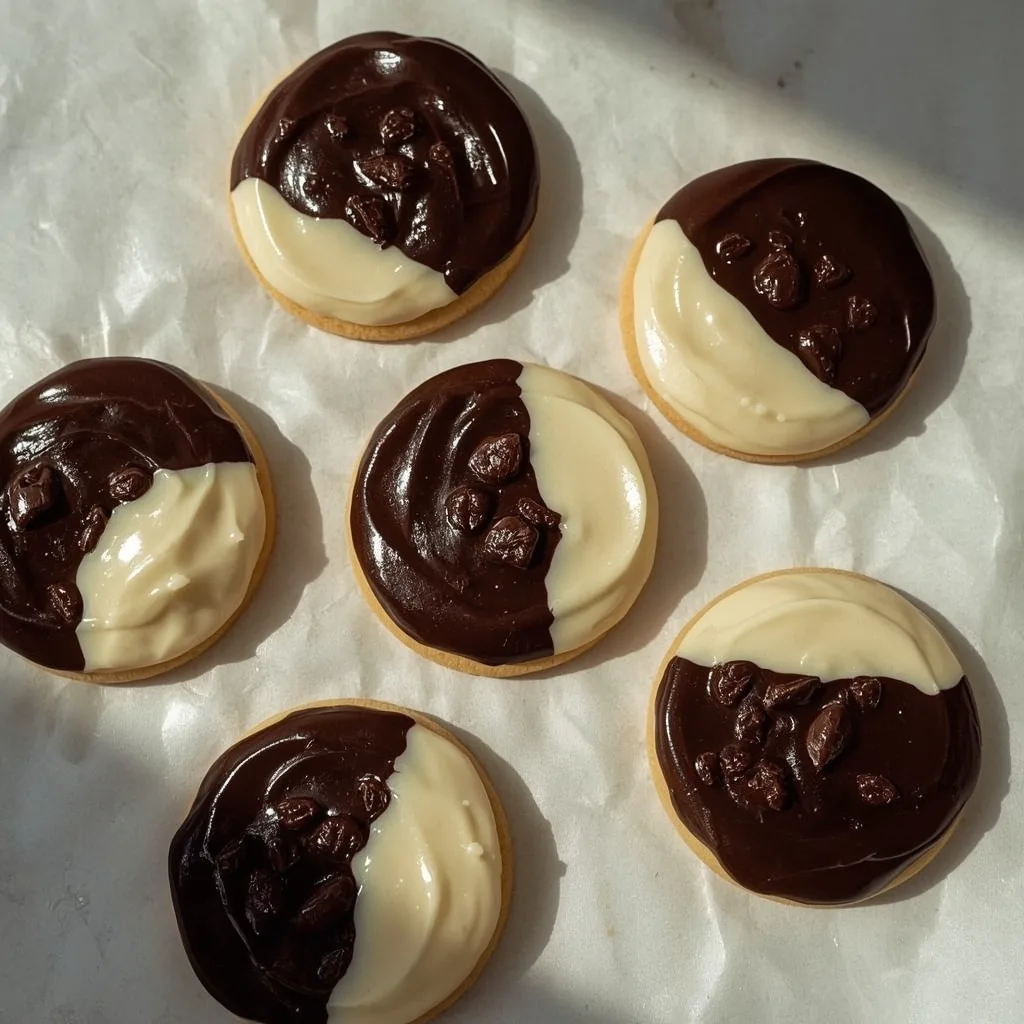
 These Ina Garten Black & White Cookies deliver the real New York bakery experience at home. A soft, cake-like cookie with a tender crumb and mild lemon-vanilla flavor sits under a thick fondant glaze split between dark chocolate and vanilla.
Plan for about 48 minutes total (30 prep, 18 bake) plus a 1-hour glaze set. This recipe lands at intermediate difficulty — the fondant glaze requires careful temperature control, but the cookie dough itself is straightforward. Best for weekend baking or when you want to impress without pulling out a dozen specialty tools.
Ina Garten Black & White Cookies Overview
New York delis and bakeries made these iconic cookies famous. The base is closer to a soft sugar cookie crossed with a yellow cake — dense enough to hold the heavy fondant but light enough to eat with coffee. Ina’s version uses a trick few home bakers know: a splash of lemon juice in the milk creates a faux buttermilk effect that tenderizes the crumb without adding tang.
The double glaze is where most recipes go wrong. A thin royal icing cracks and flakes. A ganache feels heavy. Ina uses a true fondant glaze — corn syrup-based, cooked briefly on the stove, and split into two bowls. It dries to a smooth, matte finish that stays soft enough to bite through cleanly.
Why This Recipe is Worth Trying
You probably have most of these ingredients already. Here is what makes this version stand out from the dozen others online.
- Authentic texture — The fondant glaze creates that signature chewy-yet-smooth top layer that royal icing cannot replicate. No cracking, no flaking.
- No stand mixer required — A hand mixer works fine for the creaming step. The dough is soft enough to stir by hand if you prefer.
- Lemon is the secret — That quarter teaspoon of juice changes the milk chemistry. The crumb comes out noticeably softer than recipes using plain milk.
- Bakes in under 20 minutes — Fourteen to sixteen minutes per sheet. You can have cookies cooling while the glaze simmers.
- Freezes well unglazed — Make the cookies ahead, freeze for up to two months, then glaze day-of. Fresh fondant every time without the full bake.
- Crowd-friendly size — Each cookie is substantial enough to satisfy without being oversized. Eight cookies fits most gatherings perfectly.
Ingredients You’ll Need for This Recipe
Every ingredient matters here. Here is what to grab and why.
Cookie Dough
- All-purpose flour, 1 3/4 cups (8.75 oz / 248g) — Standard AP flour works. Do not substitute bread flour; the extra protein makes the cookies dense.
- Baking soda, 1/2 teaspoon — Provides lift. Make sure it is fresh — test it in warm water; it should bubble immediately.
- Kosher salt, 1/2 teaspoon — Balances sweetness. Diamond Crystal preferred; if using Morton’s, reduce to 1/3 teaspoon.
- Whole milk, 1/2 cup (4 oz / 113ml), room temperature — Cold milk seizes the butter during creaming. Let it sit out 30 minutes before starting.
- Vanilla extract, 1/2 teaspoon — Pure vanilla, not imitation. The flavor stands out in the plain white glaze half.
- Fresh lemon juice, 1/4 teaspoon — Fresh only. Bottled juice lacks the acidity needed for the milk reaction.
- Unsalted butter, 6 tablespoons (3 oz / 85g), softened — Salted butter changes the dough’s salt balance. If using salted, omit the added kosher salt.
- Granulated sugar, 3/4 cup (5.3 oz / 150g) — Standard white sugar. Do not use superfine; it alters creaming time.
- Large egg, 1, room temperature — Cold egg can cause the butter-sugar mixture to separate. Warm it in a bowl of hot water for 5 minutes if needed.
Fondant Glaze
- Confectioners’ sugar, 2 cups (8 oz / 227g), sifted — Sifting eliminates lumps that create streaks in the glaze. Do not skip this.
- Light corn syrup, 1/2 cup (6 oz / 170g) — This gives fondant its signature texture. Do not substitute honey or maple syrup.
- Water, 1/4 cup (2 oz / 60ml) — Tap water is fine. Adjust temperature only if adjusting glaze consistency later.
- Vanilla extract, 1/2 teaspoon — Same bottle as the dough. Adds warmth to the white fondant half.
- Dutch-process cocoa powder, 2 tablespoons (0.5 oz / 14g) — Dutch-process is less acidic and dissolves smoother than natural cocoa. Hershey’s Special Dark works if you cannot find Dutch.
Useful Equipment
You do not need a bakery setup, but these tools make the process smoother.
- Half-sheet pans (2) — Standard 18×13-inch pans fit four cookies each with proper spacing. Dark nonstick pans brown faster — check at 12 minutes if using them.
- Parchment paper — Necessary for preventing sticking without greasing. The cookies spread less on parchment than on silpats.
- Stand mixer with paddle attachment — Hand mixer works, but the paddle aerates creamed butter more evenly. Either way, scrape the bowl halfway through.
- #30 cookie scoop (2 tablespoons) — Ensures even-sized cookies that bake at the same rate. If using a spoon, weigh each portion to 2.5 ounces.
- Small offset spatula — Spreads fondant cleanly across half the cookie. A butter knife works but leaves thicker edges.
Steps to Make Ina Garten Black & White Cookies
The process goes: make dough, bake, cool, make fondant, glaze. Follow the order exactly — warm cookies melt fondant instantly.
- Preheat and prep — Set oven to 350°F / 177°C. Line two half-sheet pans with parchment. No greasing — the fat causes cookies to spread into thin discs.
- Dry mix and milk mix — Whisk flour, baking soda, and salt together. In a separate cup, stir milk, vanilla, and lemon juice. The milk will thicken slightly after a minute — that is the faux buttermilk effect working.
- Cream butter and sugar — Beat softened butter and sugar on medium-high for 3 minutes until pale and fluffy. Scrape the bowl and paddle halfway — unincorporated butter chunks create greasy spots.
- Add egg — Beat on medium for 30 seconds until fully combined. The mixture should look smooth and slightly glossy. Scrape the bowl again.
- Alternate dry and wet — With mixer on low, add flour mix in three parts and milk mix in two parts, starting and ending with flour. Mix just until combined after each. Overmixing = tough cookies.
- Portion and shape — Scoop 8 dough balls using a 2-tablespoon scoop. Place 4 per pan, spaced 3 inches apart. Flatten each to 1/2-inch thick with moistened fingertips — prevents cracking during baking.
- Bake one sheet at a time — Center rack, 350°F / 177°C, 14-16 minutes. Edges just set and barely golden; centers still soft. Overbaking dries them out.
- Cool completely — 5 minutes on the pan, then transfer to wire rack. Wait until completely room temperature, about 30 minutes. Warm cookies = melted glaze.
- Make fondant — In a saucepan over medium heat, stir confectioners’ sugar, corn syrup, and water until smooth and just bubbling at edges (2-3 minutes). Remove from heat, stir in vanilla. Keep half in the pan.
- Divide and color — Transfer half of the white fondant to a bowl. Whisk cocoa powder into the pan’s remaining fondant until smooth. Thin chocolate fondant with warm water 1 teaspoon at a time if needed — it should flow like honey.
- Glaze — Using a small offset spatula, spread white fondant over the left half of each cookie. Wipe spatula clean, then spread chocolate fondant over the right half, slightly overlapping at the center. Let set at room temperature for 1 hour.
What Went Wrong and How I Fixed It
Even experienced bakers hit snags with fondant-glazed cookies. Here is what tripped me up the first few times.
- Cookies spread too thin — The parchment was lightly greased from a previous batch. Clean parchment prevents spreading. Also, flatten dough no thinner than 1/2 inch.
- Fondant crystallized before spreading — I walked away for 10 minutes and it hardened. Work in small batches: glaze 4 cookies at a time, keep the unused fondant covered with a damp cloth.
- Chocolate fondant was grainy — The cocoa powder was not sifted. Sift cocoa with a fine-mesh strainer before whisking into the warm fondant.
- Glaze melted off the cookie — The cookie was still slightly warm. Wait until cookies are fully cool — test by touching the center; it should feel room temperature.
- White fondant was too thick for smooth spreading — Added warm water 1 teaspoon at a time until it flowed like honey. Corn syrup brands vary — some make thicker fondant.
- Cookies stuck to the pan — I used wax paper instead of parchment. Wax paper melts at 350°F. Only use parchment.
Ways to Make Ina Garten Black & White Cookies Healthier
These are still cookies, but small swaps improve the nutrition profile without wrecking the texture.
- Swap half the butter for Greek yogurt — Use 3 tablespoons butter and 3 tablespoons plain full-fat Greek yogurt. The cookies stay soft but drop about 30 calories each.
- Reduce sugar in the dough — Cut granulated sugar to 1/2 cup. The fondant provides most of the sweetness; the dough base does not need the full amount.
- Use whole wheat pastry flour — Replace half the all-purpose flour with whole wheat pastry flour. Adds fiber (about 1g extra per cookie) without making the cookies dense.
- Halve the fondant glaze — Spread a thinner layer of glaze — about half the amount called for. You still get the visual split but with less sugar per bite.
- Skip the corn syrup — Substitute 1/4 cup honey mixed with 1/4 cup water for the corn syrup. The glaze will be slightly less shiny but still set firm.
Alternative Ingredients for Ina Garten Black & White Cookies
Swaps that work when you are missing something or need dietary adjustments.
- All-purpose flour → gluten-free 1:1 flour blend — Cup4Cup or King Arthur Measure for Measure work. The cookies will be slightly more delicate; handle gently when glazing.
- Whole milk → oat milk — Use barista-grade oat milk (full fat). It acidifies similarly to dairy milk and keeps the crumb soft.
- Unsalted butter → vegan butter — Miyoko’s or Earth Balance stick-style butter. Avoid tub margarine — too much water alters the dough.
- Large egg → flax egg — Mix 1 tablespoon ground flaxseed with 3 tablespoons water, let sit 5 minutes until gel-like. The cookies will be slightly less airy but still tender.
- Dutch-process cocoa → natural cocoa — Use the same amount. The chocolate fondant will be slightly more acidic-tasting but still works. Reduce water to 2 tablespoons if using natural cocoa.
- Light corn syrup → agave nectar — Use 1/3 cup agave plus 2 tablespoons water. The glaze sets a little softer but tastes cleaner.
What to Serve With Ina Garten Black & White Cookies
These cookies are perfect on their own, but pairings elevate the whole experience. Here is what works.
- Black coffee — The bitterness of a dark roast cuts through the sweet fondant. A double espresso is even better.
- Cold milk — Whole milk complements the vanilla-white glaze half. The fat in whole milk coats your mouth and balances the sugar.
- Vanilla bean ice cream — Crumble a cookie over a scoop and the textures contrast beautifully — soft cookie, creamy ice cream, smooth glaze.
- Fresh berries — Strawberries or raspberries provide acidity that cuts the sweetness. Arrange alongside cookies on a dessert platter.
- Hot tea — Earl Grey or chamomile works. The floral notes in Earl Grey echo the lemon undertone in the cookie dough.
- Mascarpone whipped cream — Whip 1/2 cup mascarpone with 1 tablespoon confectioners’ sugar until soft. Dollop on cookies for a richer dessert.
Best Tips for Ina Garten Black & White Cookies
These are the details that separate good cookies from bakery-quality ones. Every tip here comes from trial and error.
- Room-temperature ingredients matter — Cold butter does not cream properly (air pockets stay small). Cold milk seizes the butter. Set everything out 45 minutes before starting.
- Use a kitchen scale for flour — Scooping flour compacts it — you can add up to 30% more than the recipe intends. Weigh 248g for accuracy.
- Flatten dough balls with wet fingers — Dry fingers stick to the sticky dough. Dip your fingertips in water between each cookie — the dough releases cleanly.
- Bake one sheet at a time — Two sheets in the oven create uneven heat distribution. One bakes faster than the other, and neither comes out right.
- Cool cookies completely on a rack — 30 minutes minimum. Any residual warmth melts the fondant and causes streaks. You cannot rush this step.
- Keep unused fondant covered — Fondant dries fast once removed from the stove. Press a layer of plastic wrap directly onto the surface to prevent a skin forming.
- Glaze in a cool room — Kitchen temperatures above 75°F / 24°C soften the fondant. If your kitchen is warm, work near an open window or turn on the AC.
Unique Takes on Ina Garten Black & White Cookies
Once you master the original, try these variations. Each keeps the base cookie but changes the glaze or add-ins.
- Matcha white chocolate — Replace the cocoa powder with 1 tablespoon matcha powder. The green glaze pairs beautifully with the lemon in the dough.
- Orange zest version — Add 1 tablespoon fresh orange zest to the dough. In the white fondant, stir in 1/2 teaspoon orange extract. Bright and citrus-forward.
- Espresso chocolate — Dissolve 1 teaspoon instant espresso powder in the water for the chocolate fondant. Deepens the cocoa flavor without extra sweetness.
- Almond cookie base — Replace 2 tablespoons flour with almond flour. Add 1/4 teaspoon almond extract to the dough. Nutty undertones complement both glazes.
- Reverse glaze — Make the white fondant first, spread on all cookies, then drizzle chocolate in thin lines across the top. Artistic and easier for beginners.
- Mini cookie version — Scoop 1 tablespoon dough instead of 2. Bake 10-12 minutes. Makes 16 mini cookies — perfect for parties with smaller glazing sections.
How to Store Ina Garten Black & White Cookies
Proper storage keeps the fondant intact and the cookie soft. Here is how to handle leftovers.
- Room temperature, single layer — Place glazed cookies in an airtight container in a single layer. Stacking cracks the fondant. Keeps 3 days.
- Freeze unglazed only — Flash-freeze plain cookies on a sheet pan for 1 hour, then transfer to a freezer bag. Thaw at room temperature, then glaze. Keeps 2 months.
- Separate glazed cookies with parchment — If you must stack, place a round of parchment between each cookie. Works for short-term storage (24 hours max).
- Never refrigerate glazed cookies — The fridge dries out the fondant and makes the cookie base hard. Room temperature only.
- Revive stale cookies in the oven — Place on a baking sheet at 300°F / 149°C for 3-4 minutes. Cool completely before eating. This re-crisps the cookie without melting the fondant.
How to Reheat Ina Garten Black & White Cookies
These cookies are best served at room temperature. If you need to refresh them, use one of these methods.
- Oven method — Place on a baking sheet at 300°F / 149°C for 3-4 minutes. Pull them when the edges feel slightly warm. The fondant will soften but not melt if you stay close.
- Microwave (last resort) — 5 seconds on 50% power. Just enough to soften the cookie without melting the fondant. Watch carefully — 10 seconds ruins the glaze.
- Air fryer — Set to 300°F / 149°C for 2 minutes. Works well for reviving the cookie texture, but check at 90 seconds — air fryers run hot.
- Countertop rest — If the cookie has gone stale but you do not want heat, wrap it in a damp paper towel and microwave 5 seconds (exposed, not sealed). Remove paper towel and let sit 5 minutes. Moisture redistributes evenly.
FAQs
Can I freeze Ina Garten Black & White Cookies?
Only freeze the cookies unglazed. Glazed cookies develop condensation during thawing that ruins the fondant texture. Freeze unglazed cookies in a freezer bag for up to 2 months, then thaw and glaze fresh.
How long does Ina Garten Black & White Cookies last at room temperature?
Glazed cookies last up to 3 days in an airtight container at room temperature. After day 3, the cookie base dries out. Unglazed cookies in a sealed container stay fresh for 5 days.
What makes the fondant glaze set properly?
Two things: cooking the fondant until it just bubbles (2-3 minutes over medium heat) and letting the cookies cool completely before glazing. The fondant sets firm at room temperature — no refrigeration needed.
Can I use a different chocolate for the dark glaze?
Stick with Dutch-process cocoa powder for the smoothest result. Melted dark chocolate (60-70% cacao) creates a ganache, not a fondant, and will have a different texture and sheen.
How do I prevent the cookies from cracking while baking?
Moisten your fingertips when flattening the dough balls. Dry dough surfaces crack as they expand. Also, do not overmix the dough — too much gluten development creates tension that cracks the surface during bake.
Can I double this recipe?
Yes. Double all ingredients. The only change: bake in batches of 4 cookies per sheet. Do not crowd the pan — spacing is critical for even spreading and browning.
Nutritional Breakdown (Per Serving)
Based on 1 serving = 2 cookies out of 8 total — the recipe makes 4 servings of 2 cookies each.
- Calories: 512
- Protein: 6g
- Fat: 18g
- Carbohydrates: 85g
- Fiber: 1g
- Sugar: 63g
- Sodium: 399mg
Conclusion
Ina Garten Black & White Cookies deliver that classic New York bakery experience without a trip to the city. The soft, lemon-scented cookie base and the glossy split fondant are more approachable than they look — the biggest hurdle is waiting for the fondant to set. Make a batch this weekend, and see why these cookies have been a deli counter staple for decades.
PrintIna Garten Black & White Cookies

These iconic New York-style Black & White Cookies from Ina Garten feature a soft, cake-like base with a tender crumb and a slight lemon-vanilla flavor. Each large cookie is topped with a thick, glossy fondant glaze—half dark chocolate, half vanilla—creating the perfect balance of sweet and rich.
- Prep Time: 30
- Cook Time: 18
- Total Time: 48
- Yield: 4 1x
- Category: Dessert
- Method: Baking
- Cuisine: American
Ingredients
- 1 3/4 cups all-purpose flour (8.75 oz / 248g)
- 1/2 teaspoon baking soda
- 1/2 teaspoon kosher salt
- 1/2 cup whole milk, at room temperature (4 oz / 113ml)
- 1/2 teaspoon vanilla extract
- 1/4 teaspoon fresh lemon juice
- 6 tablespoons unsalted butter, softened (3 oz / 85g)
- 3/4 cup granulated sugar (5.3 oz / 150g)
- 1 large egg, at room temperature
- For the fondant glaze:
- 2 cups confectioners’ sugar, sifted (8 oz / 227g)
- 1/2 cup light corn syrup (6 oz / 170g)
- 1/4 cup water (2 oz / 60ml)
- 1/2 teaspoon vanilla extract
- 2 tablespoons unsweetened Dutch-process cocoa powder (0.5 oz / 14g)
Instructions
- Preheat the oven to 350°F / 177°C. Line two half-sheet pans with parchment paper; this ensures even heat distribution and prevents sticking without greasing, which can cause cookies to spread too much.
- In a medium bowl, whisk together 1 3/4 cups all-purpose flour, 1/2 teaspoon baking soda, and 1/2 teaspoon kosher salt. Set aside. In a small cup or liquid measuring cup, stir together 1/2 cup whole milk, 1/2 teaspoon vanilla extract, and 1/4 teaspoon fresh lemon juice. The lemon will slightly acidify the milk (a faux buttermilk effect), tenderizing the crumb.
- In the bowl of a stand mixer fitted with the paddle attachment, beat 6 tablespoons softened unsalted butter and 3/4 cup granulated sugar on medium-high speed until light and fluffy, about 3 minutes. Scrape down the bowl and paddle halfway through to ensure even creaming, which incorporates air for a soft cookie.
- Add 1 large egg to the butter-sugar mixture and beat on medium speed until fully incorporated, about 30 seconds. Scrape down the sides again. The mixture should look smooth and pale.
- With the mixer on low speed, add the flour mixture in three additions, alternating with the milk mixture in two additions, beginning and ending with flour. Mix just until combined after each addition—overmixing activates gluten and makes the cookies tough. The final dough should be soft, thick, and slightly sticky.
- Using a 2-tablespoon scoop (a #30 scoop), portion the dough into 8 evenly sized balls. Place 4 balls on each prepared baking sheet, spacing them at least 3 inches apart (they will spread). Slightly flatten each ball with moistened fingertips to about 1/2-inch thickness for even baking.
- Bake one sheet at a time on the center rack at 350°F / 177°C until the cookies are puffed and the edges are just set and barely golden, about 14 to 16 minutes. The centers should still be slightly soft when touched—do not overbake, as the cookies will continue to set on the sheet. Let cookies cool on the baking sheet for 5 minutes, then transfer to a wire rack to cool completely, about 30 minutes.
- While cookies cool, make the fondant glaze. In a medium saucepan over medium heat, combine 2 cups sifted confectioners’ sugar, 1/2 cup light corn syrup, and 1/4 cup water. Stir constantly with a wooden spoon until the mixture is smooth and just begins to bubble at the edges, about 2 to 3 minutes. Remove from heat and stir in 1/2 teaspoon vanilla extract. This is the white base—keep half in the pan.
- Transfer half of the white fondant to a separate small bowl. To the remaining half in the saucepan, add 2 tablespoons Dutch-process cocoa powder, whisking vigorously until fully incorporated and smooth. If the chocolate fondant is too thick, add warm water 1 teaspoon at a time until it reaches a thick yet spreadable consistency, like honey.
- When cookies are completely cool (any warmth will melt the glaze), use a small offset spatula or butter knife to spread the white fondant over exactly half of each cookie, covering from the center to the edge. Wipe the spatula clean, then repeat with the chocolate fondant on the other half, overlapping slightly at the center to create a clean seam. Allow glaze to set at room temperature until firm, about 1 hour. Store in an airtight container at room temperature for up to 3 days.
- If cookies are glazed more than 24 hours in advance, place them in a single layer on a parchment-lined sheet pan and cover loosely with plastic wrap. Do not stack, as the glaze may stick or crack.
Notes
Store leftover Black & White Cookies in an airtight container at room temperature for up to 3 days. For longer storage, freeze unglazed cookies in a freezer bag for up to 2 months; thaw and glaze just before serving. To re-crisp stale cookies, place on a baking sheet at 300°F / 149°C for 3 to 4 minutes, then cool completely before consuming. The fondant glaze does not freeze well.
Nutrition
- Calories: 512
- Sugar: 63g
- Sodium: 399mg
- Saturated Fat: 11g
- Carbohydrates: 85g
- Fiber: 1g
- Protein: 6g
- Cholesterol: 69mg
Keywords: black and white cookies, Ina Garten cookies, New York cookies, half moon cookies, vanilla cookies, chocolate glaze, lemon cookies, drop cookies, fondant icing, bakery style cookies